A park is a library of trees, and most of us walk past the same few species every week without ever learning their names. The good news is that you do not need a botany degree to tell an oak from an ash. You need a handful of reliable features, a little patience, and the willingness to look up.
This guide covers five trees you are almost certain to meet on a British park walk: oak, ash, beech, sycamore and horse chestnut. Leaves are the quickest place to start, but bark, buds and seeds will confirm what you suspect. Once you can recognise these five, the whole park starts to look different.
Start with the leaf: four questions that narrow things fast
Before you try to name a tree, ask four simple questions about the leaf. They will usually cut the possibilities down to a shortlist.
- Is it a single leaf or a compound leaf? A compound leaf is made of several leaflets attached to one stalk. Ash and horse chestnut have compound leaves; oak, beech and sycamore have single leaves.
- Are the leaves arranged alternately or in opposite pairs? Look at the twig. If leaves sit in pairs directly opposite each other, it is an opposite tree. Ash, sycamore and horse chestnut are opposite. Oak and beech are alternate.
- What is the edge doing? Smooth, toothed, lobed or wavy? Oak is lobed with rounded edges. Beech is wavy and slightly hairy. Sycamore is toothed and hand-shaped.
- What shape is the whole leaf? Oval, feather-like or hand-like? This is often the fastest clue of all.
Answer those four and you are already most of the way there. Bark and seeds will finish the job. If you can, pick up a fallen leaf rather than pulling one from the tree. Fallen leaves are often drier and flatter, which makes their veins and edges easier to see.
Oak
Leaf
Oak leaves are deeply lobed with rounded edges. There are no sharp points, which separates them from some ornamental oaks that have bristle-tipped lobes. The leaves grow alternately along the twig, so they stagger rather than sit in pairs. The lobes are irregular, giving the leaf a jagged, familiar outline.
Bark and other clues
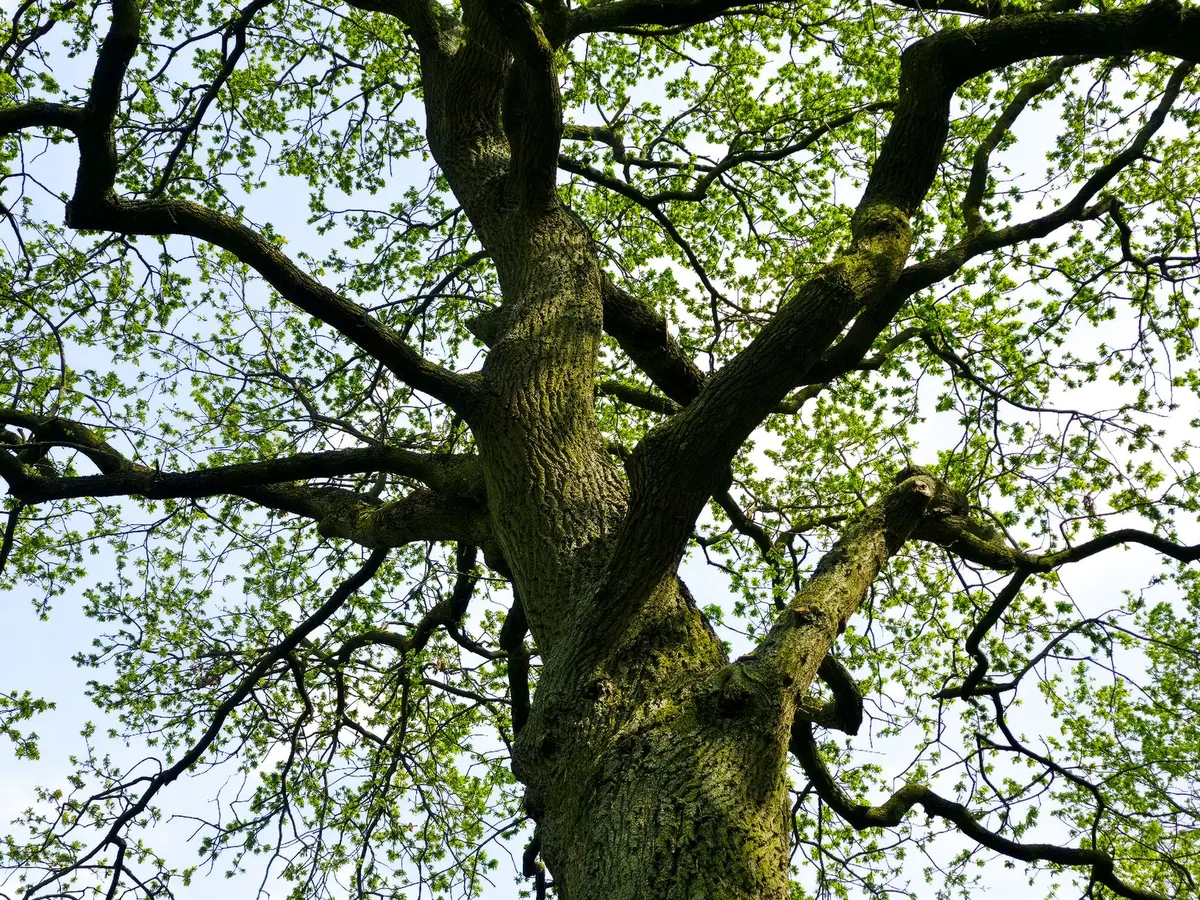
Young oaks have smooth, grey-brown bark. Older trees develop deep vertical fissures and a rugged, blocky texture that is hard to mistake once you have seen it. In autumn, look for acorns. On English oak they sit on long stalks; on sessile oak they sit directly on the twig. Both are common in parks. Oak galls are another useful clue: small round growths on leaves or twigs are often made by tiny wasps, and they are especially noticeable in late summer.
Ash
Leaf
Ash leaves are pinnate, meaning they are made up of opposite pairs of leaflets along a central stalk. You will usually count seven to thirteen leaflets, each with a toothed edge. The whole leaf can be 20 to 30 centimetres long. The leaves themselves are opposite each other on the twig, which is a major clue: most UK trees have alternate leaves, but ash, sycamore, horse chestnut and field maple are opposite.
Bark and winter buds
Ash bark is pale grey and smooth on young trees, becoming ridged in a diamond pattern with age. In winter, the buds are the giveaway: velvety black, often described as sooty. Look for them at the tips of twigs. Ash dieback has affected many trees across the UK, so you may see sparse crowns or dead branches. That does not make identification unsafe, but it does mean you should look at the whole tree rather than one feature.
Beech
Leaf
Beech leaves are oval, glossy and have a wavy, slightly hairy edge. Fine parallel veins run from the midrib to the edge. Young beech often holds on to its leaves through winter, when they turn pale brown and papery. The leaves are alternate on the twig.
Bark and buds
Beech bark is smooth and grey, often looking like an elephant's skin. It rarely develops deep fissures, even on old trees, which makes it stand out from oak and ash. The buds are long, slender and pointed, like small torpedoes, sitting alternately along the twig. In autumn, look for beech mast: small triangular nuts in prickly husks.
Sycamore
Leaf
Sycamore leaves are palmate, shaped like a hand with five main lobes and toothed edges. They are opposite each other on the twig. The leaf stalks are often reddish, and the leaves are large, sometimes up to 20 centimetres across. They turn yellow before falling.
Bark and seeds
Sycamore bark is grey and scaly, often with patches of green algae on the shaded side. In summer and autumn, look for the seeds: pairs of winged samaras that spin like helicopters. They hang in clusters and are a reliable clue. Sycamore is not native to the UK, but it is planted widely in parks and streets.
Horse chestnut
Leaf
Horse chestnut leaves are also palmate, but with five to seven leaflets that are larger and more spread out than sycamore's. Each leaflet is broad at the tip and narrow at the base, with a toothed edge. The leaflets radiate from a single stalk, so the whole leaf looks like a hand with long fingers. They are opposite on the twig.
Bark and seeds
Horse chestnut bark is grey-brown and relatively smooth when young, becoming scaly and slightly fissured with age. The best clue is the conker: a glossy brown seed in a spiky green husk. In spring, the upright white or pink flower spikes, known as candles, are unmistakable. In winter, look for the large, sticky buds with a horse-shoe-shaped leaf scar on the twig.
Bark basics: how to read a trunk without leaves
Bark is trickier than leaves because it changes with age. A young oak can look almost smooth, while an old oak is deeply cracked. Always compare several trees of the same species, and use bark as confirmation rather than your first clue.
- Oak: deep vertical fissures and thick ridges on mature trees; often covered in moss and lichen.
- Ash: pale grey with diamond-shaped ridges; the pattern is usually clearer on younger trees.
- Beech: smooth, grey and elephant-like, even when old; rarely deeply cracked.
- Sycamore: grey and scaly, with plates that flake off; green algae often grows on the shaded side.
- Horse chestnut: grey-brown and scaly, with circular leaf scars on young branches.
Look at the bark at eye level first, then step back and look higher up. Light, moisture and age all change how bark appears, so do not rely on a single patch.
Common confusions and how to avoid them
Even experienced naturalists double-check. Here are the mix-ups you are most likely to make.
- Sycamore vs horse chestnut: both have palmate leaves. Sycamore has five main lobes and seeds in spinning pairs. Horse chestnut has five to seven separate leaflets and spiky conker husks.
- Ash vs rowan: both have pinnate leaves. Ash leaves and buds are opposite; rowan leaves are alternate and its buds are not sooty black.
- Oak vs beech: oak leaves are lobed with rounded edges; beech leaves are wavy but not lobed, with straight veins and smooth grey bark.
When you are unsure, do not guess from one feature. Check the leaf arrangement, the bark, the buds and whatever seeds or husks are on the ground. Two or three clues together are far more reliable than one.
A simple park-walk routine
Try this next time you are out. It takes five minutes and builds the habit.
- Pick one tree and stand back. Note its overall shape and where it is growing.
- Look up at the leaves. Ask the four questions: single or compound, alternate or opposite, edge, shape.
- Check the twig. Are leaves and buds opposite each other or staggered?
- Look at the bark at eye level, then higher up if you can. Note colour, texture and any fissures.
- Look down. Fallen leaves, seeds, husks and nuts often give the final clue.
- Say the name out loud, then try to find a second example nearby. Repetition is what makes it stick.
Identification is not a test. It is a conversation with the tree, and every wrong guess teaches you something.
Why these five matter
Oak, ash, beech, sycamore and horse chestnut are not just common. They are also useful anchors. Once you know them, you can compare every new tree to a familiar one. Is that leaf like an oak but sharper? Perhaps it is a red oak. Is that bark smooth like beech but with different buds? Maybe it is hornbeam. The five species in this guide are the reference points that make the rest of the park readable.
And the more you look, the more you notice. You will start to see which trees leaf first in spring, which hold their leaves longest in autumn, and where the squirrels prefer to feed. That is the real reward: not just a list of names, but a richer walk through a familiar place.
Photo: Sana . / Pexels